A moving crew shows up on a Tuesday morning to a Hermosa Beach address with a truck parked two blocks away. There is no driveway to back into, no curb cut, no place for a truck to even idle near the door. Every box, every dresser, every mattress gets carried by hand down a pedestrian lane eight to twelve feet wide, past neighbors' gates and potted plants. Popeye Moving & Storage, a company that has worked South Bay addresses for decades, plans these jobs differently from a standard house call precisely because of that carry distance. This is not a quirky exception in Hermosa Beach. It is standard procedure for a meaningful slice of the city's housing stock, and it explains a pricing pattern that the median sale price simply cannot capture.
If you have been watching Hermosa Beach listings and trying to figure out what a "typical" home actually costs here, you have probably noticed the numbers don't add up to anything coherent. As of August 2026, the city's median list price sat at $1.87 million, down roughly a third from the same month a year earlier, with homes spending a median of 52 days on the market. That figure is real. It is also nearly useless for deciding what you should expect to pay for a specific kind of Hermosa Beach house, because that median describes a blended average across three markets that barely resemble each other.
One City, Three Very Different Markets
Hermosa Beach covers 1.43 square miles. Inside that footprint, pricing splits into tiers that don't overlap much at all. Homes directly on The Strand, the oceanfront walkway, have traded in the range of $4 million to $12 million or more. Homes two or three blocks inland, on regular vehicular streets, have sold in the $1.3 million to $2.2 million range. Between those two extremes sits a third category that gets far less attention in market write-ups: walk street homes, running roughly $2.5 million to $4 million.
None of those three numbers is close to the citywide median. That's the point. The median is a statistical artifact produced by averaging three markets that operate on different logic, not a price you'll actually see attached to a real house. A buyer comparing a walk street listing to "the Hermosa Beach median" is comparing it to a number that doesn't describe any actual property in the city. The only useful comparison is tier to tier: walk street to walk street, Strand to Strand, inland to inland.
To put the spread in concrete terms, a comparable 1,800 square foot home on The Strand has sold in the $6 million to $8 million range, while a similar footprint two blocks inland lands closer to $1.5 million to $2 million for the same square footage. Walk street homes sit in the middle of that spread, and understanding why requires looking at what a walk street actually is, not just where it sits on a map.
Where Hermosa's Walk Streets Actually Are
Hermosa Beach has two distinct pockets of walk streets, and they're small enough that you could walk both in an afternoon. The first is in the North end: 30th and 31st Streets, each about a block long and a block from the beach. The second, larger stretch runs one block inland of The Strand, from 21st Street down to 3rd Street, flat the entire way and close enough to smell the ocean from the front step.
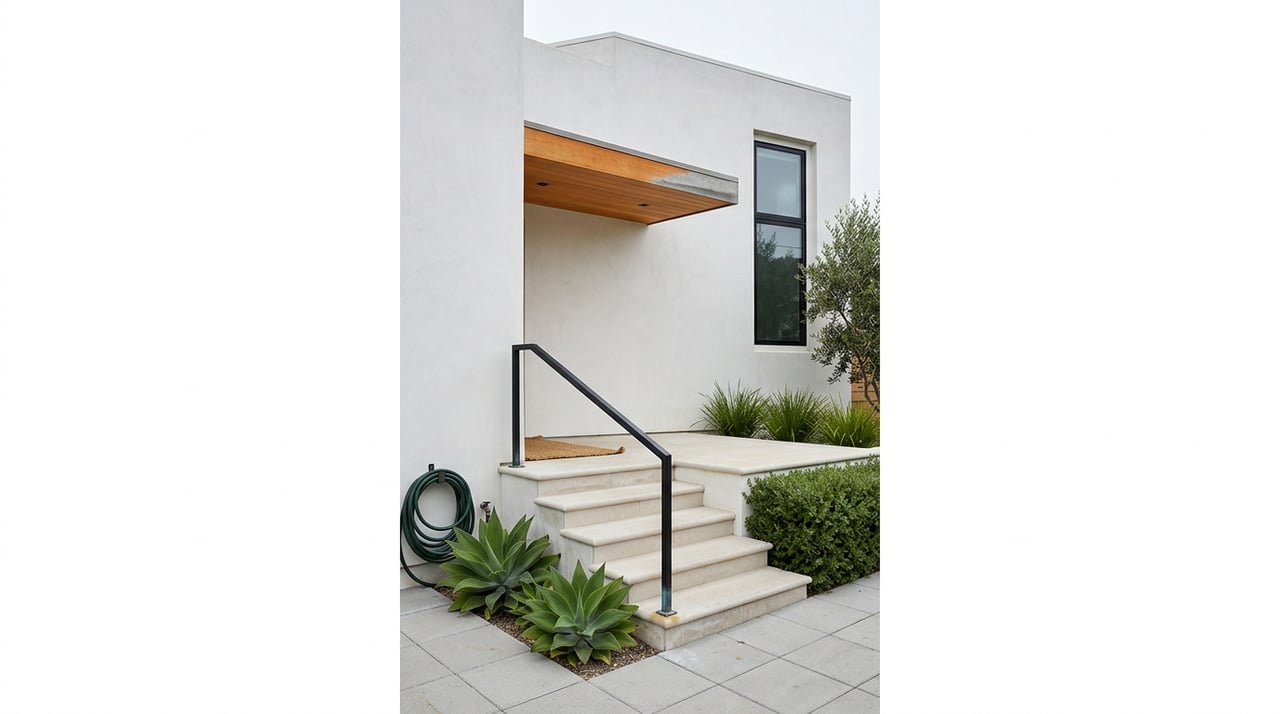
These are not driveways with landscaping. A walk street is a public pedestrian right-of-way. Homes face it the way a normal house faces a street, with a front door, a gate, sometimes a small patio, but there is no pavement for a car anywhere in the corridor. Garages and parking are accessed from the back of the lot, off Hermosa Avenue or another vehicular street, which means the "front" of a walk street house and the way you actually drive up to it are two different addresses in practice. Lots along these corridors tend to run about 30 feet of frontage, narrow by inland standards but wide enough for a genuine front yard steps from the sand, something almost nobody two blocks over gets to claim.
The Premium Is Paying for a Trade, Not Just a View
Here's where most explanations of walk street pricing get it backwards. The instinct is to assume the premium is about proximity to the ocean or a better view, the same logic that explains Strand pricing. But plenty of walk street homes don't have meaningfully better ocean views than a well-placed inland property four blocks away. What they have is something else entirely: a permanently car-free, low-traffic pedestrian environment that functions more like a shared courtyard than a street, at the direct cost of every convenience a driveway provides.
That trade cuts both ways, and it shows up in the price, not just the lifestyle. On the upside, there's no traffic noise, no risk of a car near kids playing outside, and a version of neighborhood cohesion that's rare in a coastal city this dense. On the downside, every logistics-heavy moment of homeownership gets harder. Moving day means hand-carrying furniture from a truck parked on the nearest vehicular street. A kitchen remodel means construction materials, dumpsters, and contractor parking all have to stage somewhere other than in front of the house, coordinated through the city's encroachment and right-of-way permitting process, which requires an ongoing agreement with Public Works that the city can revoke at any time. A large appliance delivery means the delivery crew is doing the same hand-carry the movers did.
None of this is disclosed on a listing sheet the way square footage or lot size is. It's the kind of friction you only discover once you're the one scheduling the moving truck or the retaining wall repair, and it's a meaningful part of why walk street pricing sits where it does relative to inland comps that offer the exact same square footage with none of the access complexity.
What This Means If You're Actually Comparing Streets
If you're deciding between a walk street home and an inland alternative at a similar price point, the comparison isn't really about square footage or even proximity to the beach. It's about which trade you're willing to make. A few things worth confirming before you get too attached to a specific address:
- Where is the actual vehicular access, and how far is it from the front door? On most walk streets, that's the back of the lot off an adjacent street, not the walk street itself.
- If you're planning any renovation, ask early how materials and equipment will stage, since a walk street address changes the logistics and the permitting timeline compared to a standard street.
- If you rely on frequent deliveries, professional moving help, or accessibility accommodations, factor in that every one of those services costs more time and often more money on a walk street than on a normal block.
None of this makes a walk street home a bad decision. For the right buyer, the trade is the entire appeal: a family-safe, low-traffic corridor within a block or two of the sand, at a price that sits meaningfully below Strand ownership. The mistake is pricing or evaluating a walk street property as if it were just a slightly-closer-to-the-beach version of an inland home. It's a different product with a different cost structure, and treating it that way from the start saves both money and frustration during escrow.
Frequently Asked Questions
Is a walk street home cheaper than a Strand home for the same square footage? Generally yes. Walk street homes have traded in the $2.5 million to $4 million range, well below Strand pricing of $4 million to $12 million or more for comparable size, though both sit well above inland pricing for the same square footage.
Can moving trucks or delivery vehicles use the walk street itself? No. Walk streets are pedestrian-only rights-of-way with no curb or driveway access. Vehicles stage on the nearest vehicular street, and belongings are carried in by hand, which is why local movers price and plan these jobs differently from a standard address.
Do walk street homes require special permits for renovation or construction staging? Any use of the public right-of-way for construction staging, equipment, or ongoing private use requires an encroachment permit through the City of Hermosa Beach's Public Works Department, a process worth starting well before your projected construction date.
Comparing tiers, streets, and access realities like these is exactly the kind of groundwork that should happen before you write an offer, not after. If you're weighing a walk street address against a Strand property or an inland comp, the Merritt & Sanderson Team can walk the actual streets with you and price the tier you're really buying into.